7 Speaker Cleaning Myths That Kill Phones
Rice, loud music, hair dryers, IP68 and the hard shake — seven widely repeated fixes examined against what actually happens inside the phone.
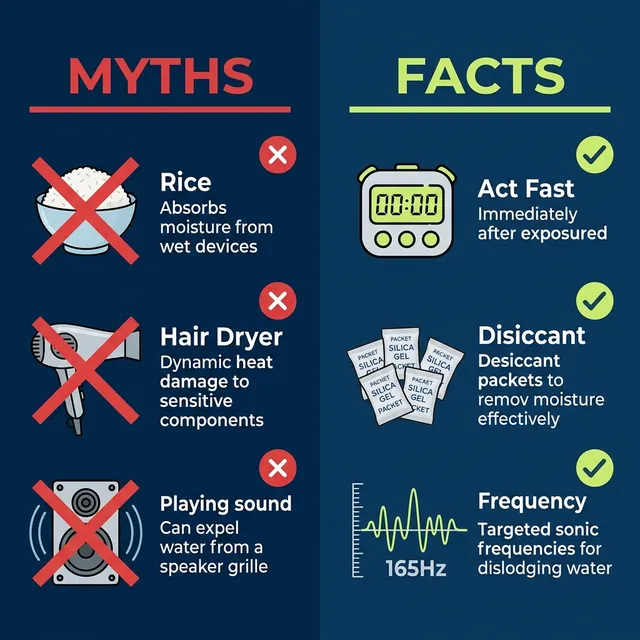
Most speaker-cleaning advice treats drying as the goal. It is not. The damage comes from liquid water touching metal and from dissolved solids left behind when it evaporates, so the answer is physical displacement quickly, not slow evaporation.
Most speaker-cleaning advice online is copied from other speaker-cleaning advice online, and a fair amount of it survives purely because it sounds plausible. Here are six claims worth examining, and what is actually going on in each case.
Myth 1: Rice will draw the water out
What people believe: uncooked rice acts as a desiccant strong enough to pull water out of a phone.
What happens: rice absorbs water vapour from the air inside a sealed container. That is a genuinely different thing from extracting liquid water from inside a device. There is no mechanism by which rice reaches a droplet sitting against a speaker diaphragm behind a metal mesh — there is no airflow path and no capillary connection.
Meanwhile rice sheds starch dust, which finds its way into charging ports and speaker grilles, and the day or two you spend waiting is a day or two the water spends in contact with metal contacts.
Do instead: displace the water physically with acoustic ejection in the first ten minutes, then air-dry. The speaker cleaner will run the cycle from any browser. Silica gel is a genuinely better desiccant if you want one.
Myth 2: Playing loud music will shake the water out
What people believe: any loud audio creates vibration, and vibration pushes water out, so maximum-volume music should work.
What happens: it is not volume that ejects water, it is diaphragm displacement. Water is held in the grille by surface tension, and breaking that bond needs the cone to physically travel.
Excursion falls as frequency rises. A low tone moves the diaphragm through a wide sweep; a high tone barely moves it at all. A music track spreads its energy across the whole spectrum, with most of it well above the range that produces useful movement — so a loud track at 3 kHz does far less than a quiet tone at 165 Hz.
That is the reason a low tone works and “play something loud” mostly does not.
Myth 3: A hair dryer speeds things up safely
What people believe: warm moving air dries things faster, and faster is better.
What happens: two problems. Heat softens the adhesives holding internal components and the acoustic mesh in place — phone assembly adhesives are not rated for sustained hot-air-gun temperatures. And heating the air inside the device makes it expand, which pushes moisture inward through whatever path is available before it eventually escapes.
Ambient-temperature moving air gets you most of the drying speed with none of the risk, and the water ejection cycle does the displacement part first. A desk fan pointed at an upright phone is genuinely a good option.
Myth 4: An IP68 phone cannot get water damage
What people believe: the phone is rated waterproof, so water is not a concern.
What happens: IP68 is a laboratory rating under IEC standard 60529, measured in fresh water, at a specified depth, for a specified time, on a new device. Apple’s own wording is that splash, water and dust resistance are not permanent conditions and that resistance might decrease as a result of normal wear — and that liquid damage is not covered under warranty.
Apple also spells out what the rating does not cover: swimming, showering, salt water, pools, soap, steam, pressure, or repeated exposure. Every one of those is a normal thing people do with a phone they believe is waterproof.
Beyond that, the rating covers ingress into the sealed body. It says nothing about the speaker grille, which is by necessity an opening to the outside world. A phone can be entirely undamaged internally and still have a grille full of pool water.
And the water matters. Seawater, chlorinated pool water and soapy water are all more aggressive than the fresh water used in the test, and all leave residue behind when they evaporate.
Myth 5: A vacuum cleaner is the safe alternative to compressed air
What people believe: suction pulls debris out rather than pushing it in, so a vacuum is strictly better.
What happens: the direction argument is correct and is why vacuum suction genuinely outranks compressed air. But household vacuums have two problems: they generate significant static charge, and at the distance that is safe for the mesh, the suction is too diffuse to do much.
A low-power vacuum designed for electronics is a reasonable tool, and sits mid-table in the full method comparison. A Dyson hose held against your phone is not the same thing.
Myth 6: If it sounds fine now, the water is gone
What people believe: audio came back after a few hours, so the problem resolved itself.
What happens: water evaporating is not the same as water being removed. Everything that was dissolved in it stays behind — salt, chlorine compounds, tap-water minerals, sugar from a spilled drink.
That residue is hygroscopic, meaning it re-absorbs humidity from the air. It is also conductive when damp. This is why some phones sound fine for a week after a soaking and then develop a crackle, or why muffling returns on a humid day.
If the exposure was anything other than clean fresh water, a brief rinse with clean water followed by proper drying is the right response, even if the phone currently sounds normal.
Myth 7: Shake the phone hard to get the water out
What people believe: a few sharp flicks of the wrist will throw the water clear, the way you shake water off your hands.
What happens: you drive it inward.
A phone is not a sealed cup with one opening. It is a stack of cavities connected by gaskets, ports and adhesive seams. Water sitting harmlessly in the shallow channel of a speaker grille has somewhere much worse to go, and a hard shake supplies exactly the force to move it there — past the acoustic mesh, into the driver chamber, along the cable channels toward the board.
The same applies to the flick people do with the charging port pointed down. Gentle, controlled movement with the speaker facing the floor is useful. Whipping the phone is not.
Do instead: hold the device speaker-down and let gravity work while a low tone does the pushing. Displacement without impact.
The pattern underneath all seven
Most of these share a structure: they treat drying as the goal. Get the water out of the air, wait long enough, apply heat, and the problem resolves.
But the thing damaging your phone is not humidity. It is liquid water in direct contact with metal, and dissolved solids left behind when that water goes. Both call for physical displacement, quickly — not slow evaporation.
That reframe is why the ranking in our comparison of nine cleaning methods looks different from most lists you will find, and why the methods that top it are the ones that move water rather than wait for it.
Sources
- Apple Support: liquid-detection alerts on iPhone
- IEC 60529 — the standard behind IP ratings
Last verified July 2026.
Frequently asked
Does the rice trick work for a wet phone?
No. Rice absorbs water vapour from air in a sealed container, and there is no mechanism by which it reaches a droplet behind a metal speaker mesh. It also sheds starch into ports and costs you the hours that actually matter.
Will playing loud music get water out of my speaker?
Not reliably. Ejection depends on how far the diaphragm travels, not how loud the sound is, and excursion falls as frequency rises. A quiet low tone moves the cone much further than loud music centred well above it. Turning the volume up does increase pressure, but it cannot compensate for the frequency being wrong. A quiet tone at the right pitch outperforms loud music at the wrong one.
Is an IP68 phone safe to swim with?
No. IP68 is a laboratory rating in fresh water on a new device. Apple states resistance is not permanent, decreases with normal wear, and is not covered by warranty — and explicitly excludes swimming, showering, salt water, pools, soap and steam.
Why do water eject tools all use 165 Hz?
Because low frequencies produce the largest diaphragm movement, and that movement is what breaks the surface tension holding water in the grille. 165 Hz is low enough for strong excursion on a small phone driver and high enough that the driver reproduces it cleanly instead of distorting.
My phone sounds fine after drying — is the water gone?
Not necessarily. Water evaporating is not water being removed, and dissolved salt, chlorine and minerals stay behind as a residue that re-absorbs humidity. That is why some phones develop a crackle a week later or sound worse on humid days.