9 Speaker Cleaning Methods Compared
Rice, silica gel, compressed air, tape, alcohol and acoustic cleaning — what each one physically does, and which ones damage the mesh.
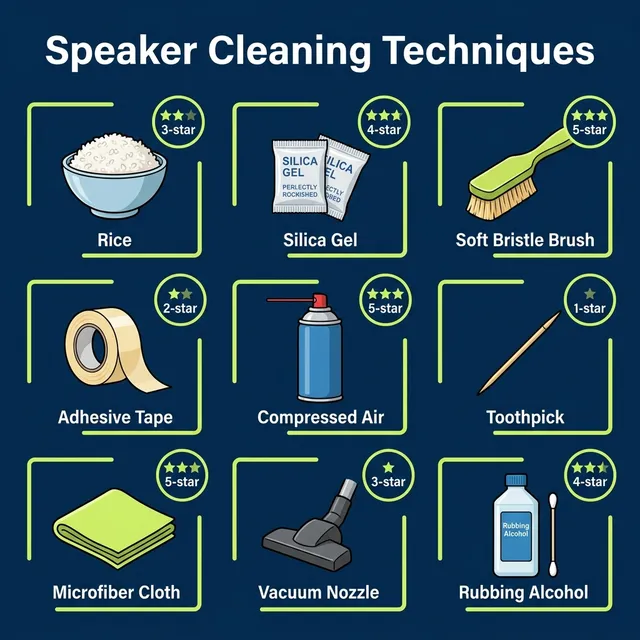
Cleaning methods split into two groups: those that displace debris and those that wait for it to evaporate. Acoustic cleaning, brushing and tape displace. Rice and silica gel wait. On a wet speaker only displacement helps, because water is corroding contacts while you wait.
Nine methods come up every time someone asks how to clean a phone speaker, and most of them are described by how well they supposedly work rather than by what they actually do. This page takes the other approach: each method is set out by the physical mechanism it uses, how long it takes, and what it can damage.
Two things worth stating first. Water and dust are different physical problems and no single method is best for both. The methods also split cleanly into two groups — those that displace debris and those that wait for it to evaporate — and that distinction decides which ones are worth reaching for first.
Displacing beats waiting
Water sitting against a speaker diaphragm is doing two things. It is bridging metal contacts at different potentials, which starts electrochemical corrosion. And it is carrying dissolved solids — salt, chlorine compounds, tap-water minerals, sugar — that stay behind as a conductive crust once the water evaporates.
Both processes are time-dependent. That is the entire argument against rice and in favour of anything that moves water out now.
| Method | What it physically does | Time | Main risk |
|---|---|---|---|
| Acoustic cleaning | Vibrates the diaphragm to push debris out of the grille | 60 seconds | None — nothing touches the device |
| Soft-bristle brush | Lifts surface lint out of the mesh openings | 1–2 minutes | Drives lint inward at the wrong angle |
| Adhesive tape | Lifts loose lint off the grille face | 1 minute | Strong adhesives leave residue |
| Isopropyl alcohol 90%+ | Dissolves the grease binding dust to the mesh | 2 minutes | Adds moisture if concentration is too low |
| Vacuum suction | Pulls debris outward, away from the chamber | 1–2 minutes | Static charge; suction too diffuse at safe distance |
| Silica gel | Absorbs water vapour from air in a sealed container | 12–24 hours | Cannot reach liquid water inside a cavity |
| Dry cloth | Blots surface moisture off the grille face | Seconds | Wiping pushes water sideways into the mesh |
| Rice | Absorbs ambient humidity, slowly | 24–48 hours | Sheds starch; costs you the critical first hours |
| Compressed air | Blows loose dust off the grille face | 1–5 minutes | Forces water past the mesh into the driver |
| Toothpick or needle | Physically dislodges visible debris | Seconds | Punctures a mesh tens of microns thick |
On a wet speaker, only the first four do anything useful in the first ten minutes — and compressed air actively makes it worse.
Acoustic cleaning
Playing a tone through the speaker to vibrate debris loose. Low frequencies around 165 Hz produce the diaphragm excursion that breaks water’s surface tension; high frequencies from 8 kHz to 16 kHz produce the rapid oscillation that breaks dust adhesion.
It ranks first for one structural reason: nothing touches the device, so there is no mechanism by which it can damage the mesh. Every mode on this site works that way. It is also the only method that acts on debris from behind rather than reaching in from the front.
Its limit is real. It moves loose and lightly bonded material. Dust that has combined with skin oil into a compacted film needs mechanical help too.
Soft-bristle brush
A dry toothbrush or a dedicated electronics brush, swept side to side at a shallow angle.
The detail most guides omit is that angle matters more than pressure. Brushing perpendicular to the grille drives lint deeper into the mesh. Brushing across it at a shallow angle lifts material out. Tap the brush clean between strokes or you redistribute the same dust.
Isopropyl alcohol, 90% or higher
For dust bonded with skin oil, alcohol is the only thing here that dissolves the binder. Apply a barely damp cotton swab around the grille perimeter, never inside it, and never apply liquid directly.
Concentration is not a detail. 70% isopropyl is 30% water by definition, and it evaporates slowly enough to leave moisture behind — the opposite of what you want. 90% or higher flashes off in seconds.
Compressed air
Effective on loose surface dust, harmful in most other situations, which is why it sits mid-table despite being the most-recommended method on the internet.
If you use it: keep the can upright so propellant does not spray out as liquid, hold it at least 15 cm away, and use short bursts at an angle across the grille rather than straight into it. A close-range blast can rupture the mesh.
Never use compressed air on a wet speaker. It converts a surface problem into an internal one.
Silica gel
Genuinely better than rice, and usually mentioned in the same breath, which understates the gap. Silica gel is an engineered desiccant and does not shed particles into your ports.
But it still only addresses humidity in a sealed container over many hours. It does nothing for water sitting against a diaphragm. Use it after acoustic ejection, for residual internal moisture — not instead of it.
Vacuum suction
A small nozzle held near the grille pulls debris outward, which is the correct direction. That directional advantage is why it outranks compressed air despite being weaker.
Household vacuums have two problems: they generate static, and at the distance that is safe for the mesh the suction is too diffuse to accomplish much. A low-power electronics vacuum is a different proposition from a Dyson hose.
Rice
The most recommended method on the internet and among the least effective.
Rice absorbs water vapour from air in a sealed container. There is no mechanism by which it reaches a droplet already inside a cavity behind a metal mesh — no airflow path, no capillary connection. Meanwhile it sheds starch dust into charging ports, and the day or two you spend waiting is time water spends against metal contacts.
If the choice were rice or nothing, rice is marginally better than nothing. That is the strongest case available for it.
Toothpick or needle
Do not.
Speaker mesh is a few tens of microns thick. A toothpick concentrates enough force through a small enough point to deform or puncture it, and once the mesh is compromised the acoustic response changes permanently and more debris gets in. The visible material you are trying to pick out is almost always at the mesh surface, where a brush removes it without risk.
What to actually do
Water: run acoustic water ejection immediately, blot the surface, leave the device speaker-down in moving air. Both modes sit together on the free cleaning tool if you are not sure which applies. Silica gel overnight if you have it.
Dust: run the high-frequency sweep, then a soft brush, then the sweep again. Alcohol only where there is visible grease.
Either: never compressed air on a wet speaker, and never anything rigid in the mesh.
Sources
- IEC 60529 — the standard behind IP ratings referenced throughout this site
- Apple Support: liquid-detection alerts — manufacturer guidance on charging a wet device
Last verified July 2026.
Frequently asked
What is the best way to clean a phone speaker?
Acoustic cleaning first, because nothing touches the device and there is no way to damage the mesh. Follow with a dry soft-bristled brush swept at a shallow angle for anything the tone leaves behind. Use 90% isopropyl only where there is visible grease.
Is compressed air safe for phone speakers?
Only on a dry speaker, at 15 cm or more, in short bursts angled across the grille. Never on a wet one — the blast forces water past the mesh into the driver chamber, turning a surface problem into an internal one.
Is silica gel better than rice for a wet phone?
Yes, meaningfully. Silica gel is an engineered desiccant and does not shed particles into ports. But it still only addresses humidity in a sealed container over many hours, so use it after acoustic ejection rather than instead of it. Both belong to the same category of slow, passive drying. Neither can act on water that is already inside a cavity, which is why displacement has to come first.
Can I use a toothpick to clean my speaker grille?
No. Speaker mesh is a few tens of microns thick and a toothpick concentrates enough force to deform or puncture it. Once the mesh is compromised the acoustic response changes permanently and more debris gets in. A soft-bristled brush reaches the same debris without the risk, because the material you can see is sitting at the mesh surface rather than wedged behind it.
Why does 70% isopropyl alcohol not work as well as 90%?
Because 70% isopropyl is 30% water by definition. It evaporates slowly enough to leave moisture behind, which is the opposite of what you want near a speaker. 90% or higher flashes off in seconds. Higher concentrations also dissolve the skin oil binding old dust to the mesh more readily, which is the reason to reach for alcohol rather than a brush in the first place.